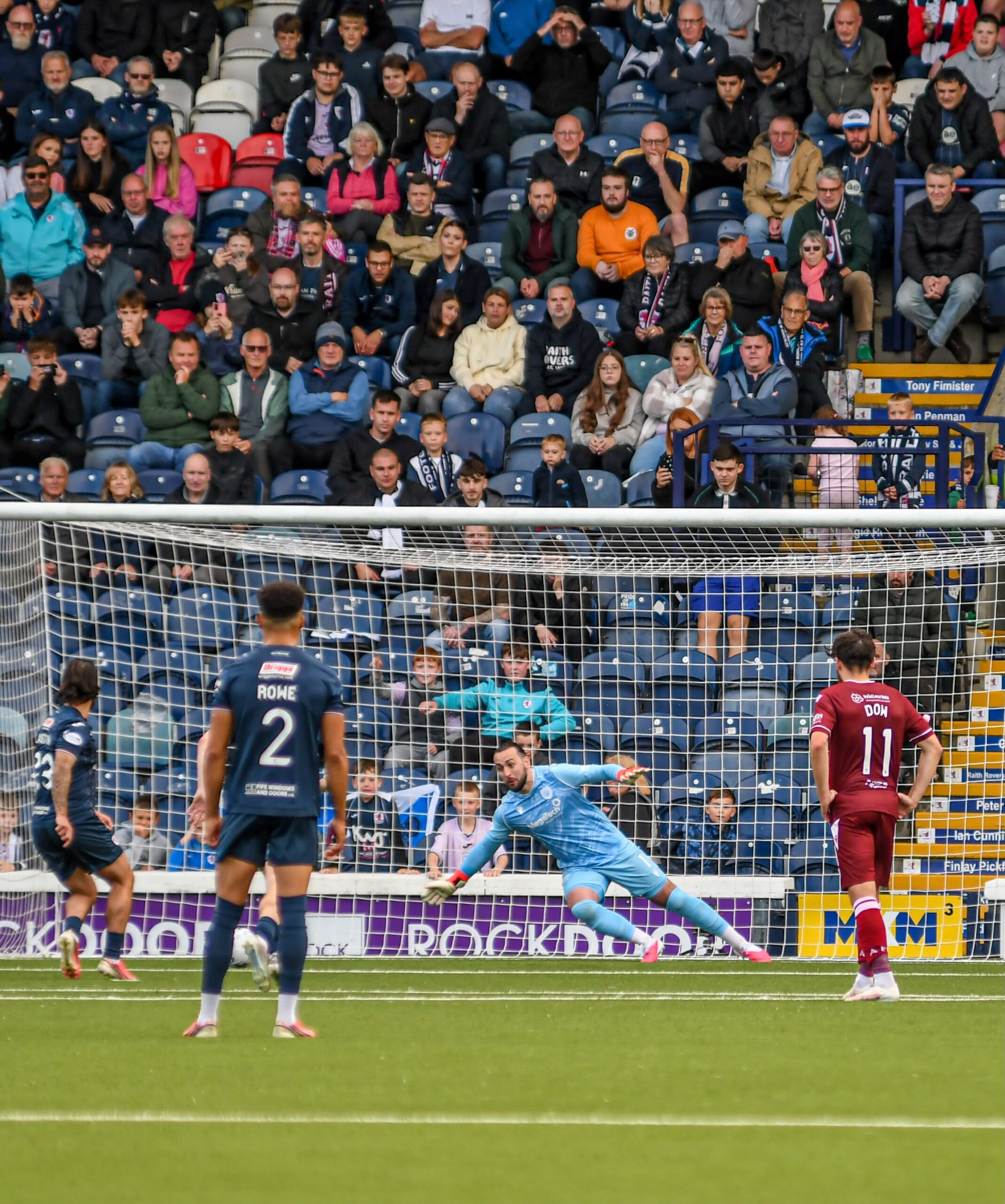
Football has always liked its absolutes.
Win or lose. In or out. Promotion or relegation. Three points gained or three points dropped. By the time the final whistle goes, the league table gives everyone a neat answer in black and white.
Anyone who has spent long enough watching the game knows it is rarely that simple.
Arbroath supporters hardly need reminding. Following the Lichties has meant experiencing just about every shade football can produce: memorable wins, agonising defeats, promotions, relegations, cup runs, great escapes and afternoons when you leave Gayfield wondering how on earth the same match could have looked completely different to the supporters standing at the other end.
Black and white, as it happens, has also been a familiar sight on the other side of the pitch.
Over the decades, Arbroath have repeatedly crossed paths with clubs whose famous colours provide a neat contrast to the maroon of the Lichties. Queen’s Park, Dunfermline Athletic and St Mirren are among the best-known examples, and each has played its own part in Arbroath’s story.
But the scoreline has never told all of it.
Few names demonstrate the depth of Scottish football quite like Queen’s Park.
The Glasgow club’s famous black-and-white hoops are among the most distinctive colours in the Scottish game, while meetings with Arbroath stretch back far beyond the modern league era.
Their paths first crossed all the way back in the nineteenth century, when Scottish football looked rather different from the game we know today. More than 140 years later, they are still capable of lining up on opposite sides of a competitive league fixture.
That extraordinary span is part of what makes Scottish football what it is. Grounds change, competitions are reorganised and generations of players come and go, yet familiar names keep returning.
The latest chapter came at Gayfield in September 2026.
Andy Winter and Rudi Molotnikov struck in the first half to put Arbroath in control against the Spiders. Queen’s Park pulled one back through Oliver Fisher after the break, ensuring a tense conclusion, but the Lichties held on for a 2-1 Championship victory.
On paper, it is beautifully straightforward: Arbroath 2, Queen’s Park 1.
The reality was considerably less tidy. Queen’s Park had possession, created opportunities and made Arbroath work for the points. Arbroath, crucially, took their chances.
Three numbers on a results page can never quite explain 90 minutes.
Dunfermline Athletic provide another familiar flash of black and white.
Arbroath and the Pars have met countless times across different divisions and different eras, creating the sort of fixture that can mean something entirely different depending on when you happen to encounter it.
Sometimes it is another Saturday on the league calendar. Sometimes considerably more is at stake.
There was certainly nothing routine about their meeting at Gayfield in February 2026. In torrential conditions, Arbroath emerged with a 4-2 victory in a six-goal contest that swung back and forth before the Lichties eventually made the points safe.
A few months later, Dunfermline would have the final word in a far more consequential encounter. The sides were paired together in the Premiership play-offs, with a single goal across two legs ultimately enough for the Pars to progress.
By September, they were at it again.
Mikey McKenna put Arbroath ahead at Gayfield before Josh Cooper levelled for Dunfermline, leaving the clubs to share the points in a 1-1 draw. Once again, what looked wonderfully clear in the results column felt far less certain while the match itself was unfolding.
That is football.
The same two clubs can produce six goals in one meeting, one decisive goal across two play-off matches in another, then finish deadlocked the next time around.
Try predicting that with complete confidence.
Perhaps that is ultimately why people keep coming back.
Football invites prediction while constantly reminding us how unreliable predictions can be.
Supporters look at the table. They check recent form. They consider injuries, previous meetings and home advantage. Managers spend entire weeks studying opponents. Analysts have access to quantities of data previous generations could barely have imagined.
Then somebody scores after 40 seconds.
A goalkeeper has the game of his life.
A shot takes a deflection.
The wind coming off the North Sea turns a straightforward cross into anything but a straightforward cross.
And suddenly all those carefully constructed expectations have to be thrown away.
There is an obvious appeal in trying to anticipate an uncertain outcome. It is something that extends beyond football into other forms of entertainment built around probability and chance, including platforms such as Betpanda Casino.
But football has an advantage that no calculation can properly capture: the emotional investment.
For the supporter standing inside Gayfield, probability quickly becomes irrelevant when Arbroath are protecting a one-goal lead with five minutes remaining.
St Mirren provide another famous set of black-and-white stripes and another opponent woven through different periods of the club’s history.
The sides were meeting in league football at Gayfield as far back as the 1930s and 1960s, including a 1-1 Division Two draw in September 1967 in which Dennis Bruce scored a late Arbroath equaliser.
Almost six decades later, the clubs were still meeting.
St Mirren visited Gayfield for a pre-season fixture in June 2026, with Ryan Dow giving Arbroath an early lead before the Premiership side eventually came through 4-2.
Different players. Different managers. Different competitions and circumstances.
Same patch of grass beside the North Sea.
There is something reassuring about that continuity.
Football spends so much time looking ahead that it can be easy to forget how much of its appeal comes from what went before. Every fixture carries a little baggage from previous meetings. Every opponent brings memories attached to a badge, a ground, a set of colours or a particular afternoon.
Maybe that is the real point.
Football needs black and white. Without the final score, the standings and the hard numbers, there would be no competition.
But the reason we care about those numbers lies in everything surrounding them.
A 1-0 victory can be comfortable or desperate.
A draw can feel like a triumph or two points thrown away.
A season judged disappointing in May can contain an afternoon supporters will still be talking about 20 years later.
One fan’s stonewall penalty is another’s blatant dive. One team’s tactical masterclass is another supporter’s afternoon of watching ten men sit behind the ball. Even the same result can look entirely different depending on which scarf you happen to be wearing.
And Arbroath’s long history offers more than enough examples.
So whenever another team in black and white runs out opposite the Lichties, the colours themselves might be straightforward.
What happens after the whistle rarely is.
Because in football, almost nothing is completely black and white.